Historical Documents Linked to WW2 Transferred to Memorial Institutions with the Support of the Auschwitz-Birkenau Foundation
On 23 October, a ceremony was held at the Ministry of Culture and National Heritage in Warsaw to transfer historical documents related, among other subjects, to the Second World War, the Holocaust, and German Nazi concentration camps. The documents were secured by the Auschwitz-Birkenau Foundation through international cooperation following the cancellation of a controversial auction in Germany in November last year.
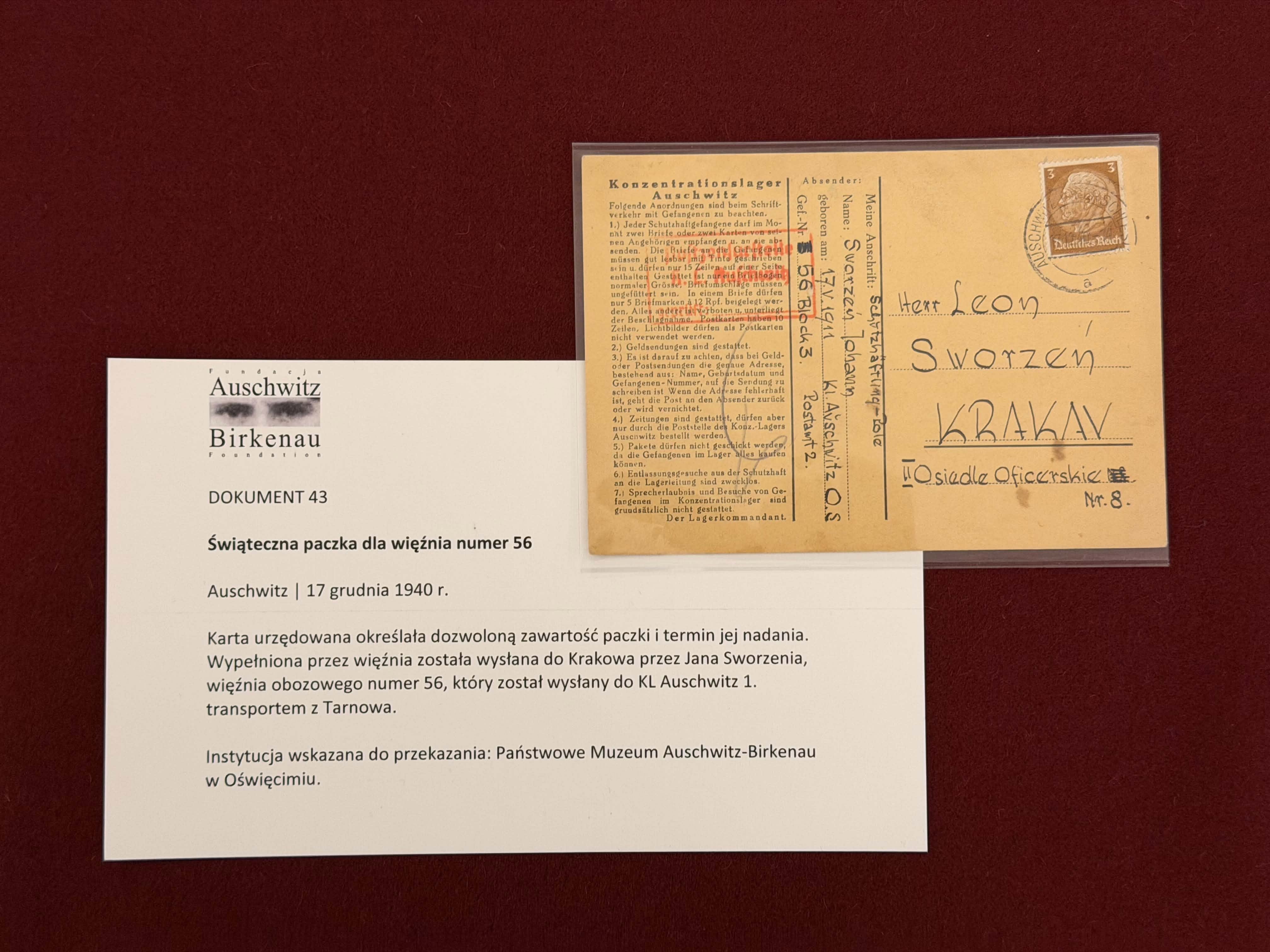
A collection of documents relating to the history of the Auschwitz, including prisoner correspondence from different periods of its operation, was transferred to the Museum Archives. Among the oldest materials is a document sent on 17 December 1940 by Jan Sworzeń, prisoner no. 56, who was deported to Auschwitz in the first transport of Polish political prisoners on 14 June 1940. It is a printed notice to his family concerning the rules for sending Christmas parcels. Jan Sworzeń died in the camp on 6 January 1943.
The collection also includes an extensive handwritten manuscript by Arthur Liebehenschel, commandant of Auschwitz in 1943–44. The document was created in 1947 during his imprisonment in Poland, in connection with preparations for his trial before the Supreme National Tribunal. The notes, bearing his handwritten signature, constitute an important source for research into the functioning of the camp and the responsibility of its perpetrators.
Other materials connected with the history of Auschwitz include prisoners’ letters, family correspondence, documents concerning the sending of parcels and money, as well as death notifications. Particularly important are those sources that reveal the individual fates of people whose stories have often survived only in fragments within camp documentation.
“Behind every document lies the tragedy of a particular person, sometimes of a group of people. Each of these stories forms part of the greatest tragedy in the history of Europe. We cannot allow the fates of individual people to remain outside the historical, archival and scholarly legacy, to end up in collectors’ drawers, private storage spaces or amateur files. When that happens, from the perspective of the Shoah as a whole and the history of the camps, the actual presence of a particular Victim disappears,” emphasized Dr Piotr M. A. Cywiński, Director of the Auschwitz Museum.
The event in Warsaw was attended by Minister of Culture and National Heritage Marta Cienkowska; Nathanael Liminski, Minister for Federal and European Affairs, International Relations and Media of North Rhine-Westphalia; Wojciech Soczewica, Director General of the Auschwitz-Birkenau Foundation; as well as representatives of the diplomatic corps, museums, archives and memorial institutions.
“Documents are becoming increasingly important witnesses to history, and it is on them that we must base a responsible policy of remembrance. A policy that protects authentic sources, ensures the conditions for independent research, and allows us to understand the past in all its complexity,” said Minister of Culture and National Heritage Marta Cienkowska.
“Behind every document stands a human being. Someone who had a family, someone who had plans and dreams, someone who loved, who longed for others, who feared for those closest to them. Someone whose normal life was taken away by the war, and often their future as well,” she added.
“At a time when disinformation and the manipulation of facts are becoming an increasingly serious threat, including to the memory of the Second World War, the Holocaust and the crimes of totalitarian regimes, our response must be strong institutions of remembrance, professional archives, the digitization of collections, historical education and international cooperation,” Minister Cienkowska said.
“We cannot rely every time solely on public protests, the goodwill of donors and extraordinary rescue efforts. That is why today I am appealing to all individuals and institutions in possession of camp documents, prisoners’ correspondence, testimonies of life in the ghettos, or personal belongings of victims of persecution: entrust them to museums, archives and memorial sites. Give historians the opportunity to study them, and future generations the opportunity to learn the stories preserved within them,” she emphasized.
In addition to the Auschwitz Museum, recipients of the documents included the State Museum at Majdanek, the Stutthof Museum in Sztutowo, the Gross-Rosen Museum in Rogoźnica, the Treblinka Museum, the Pawiak Prison Museum, the Museum of the Martyrdom of Greater Poland – Fort VII, the Warsaw Ghetto Museum, the Katyn Museum in Warsaw and the Central Museum of Prisoners of War. Documents were also transferred to the Emanuel Ringelblum Jewish Historical Institute and the State Archive in Łódź.
The scope of the initiative extends beyond Poland. Recipients also included the Holocaust Memorial Center in Budapest, as well as the embassies of the Czech Republic, Denmark, Lithuania and the Netherlands in Poland. The materials concern, among other subjects, the history of the Theresienstadt ghetto, the Westerbork and Amersfoort camps, the persecution of Jews in Hungary, and the occupation of Lithuanian territories.
Some Auschwitz-related documents were transferred to other institutions. The Central Museum of Prisoners of War received, among other items, a card sent in November 1943 from Oflag XVII A to a Polish internee in Switzerland. In it, the sender asked for help for a woman imprisoned in Auschwitz II-Birkenau, providing her prisoner number and the camp address.
Other transferred materials document, among other things, everyday life in ghettos, the fate of families separated by persecution and forced labour, and attempts to maintain contact with relatives. The Jewish Historical Institute received, among other items, a collection of 85 postcards belonging to the Markowicz family from Wieruszów. Their correspondence from 1941–1943 documents the fate of family members sent to various forced-labour camps. The State Archive in Łódź, in turn, received documents relating to deportations from the Łódź ghetto and the functioning of its administration.
The ceremony in Warsaw marked the symbolic conclusion of a process that began in November last year, when more than 600 original documents from concentration camps, ghettos and other sites connected with German crimes during the Second World War were due to be auctioned by an auction house in Neuss, Germany. They included prisoners’ letters and postcards, administrative documents and personal testimonies of persecution. International protests led to the cancellation of the auction.
Thanks to cooperation between the Auschwitz-Birkenau Foundation, the authorities of the state of North Rhine-Westphalia, German memorial institutions and private donors, more than 600 historical documents were secured. The first 433 of them were entrusted to the Foundation during a ceremony at the Parliament of North Rhine-Westphalia on 30 January 2026. Some of the collections had already been transferred earlier to memorial institutions in Germany.
The operation to secure the archival materials, halt the auction and carry out the fundraising effort would not have been possible without the personal involvement of partners from North Rhine-Westphalia, who supported the Foundation pro bono. Particular thanks and recognition are due to Matthias Schreiber of the Parliament of North Rhine-Westphalia, Ekkehardt Thiesler, Chairman of KD-Bank, and notary Klaus Oertel. Their professional advice, expert knowledge and organizational support at every stage were invaluable to the success of this sensitive mission.
“When news emerged last year that an auction house near Düsseldorf intended to put hundreds of objects connected with the Holocaust up for auction, it provoked widespread outrage. That outrage was heard particularly strongly in Poland, here, where the German perpetrators committed most of their crimes. And rightly so, because it is difficult to accept that mementos of Holocaust victims, letters from concentration camps, or yellow stars should now become objects of trade and collectors’ items. History is not a commodity. History is a responsibility we carry,” said Minister Nathanael Liminski.
The preservation of these documents was made possible through the involvement of the Auschwitz-Birkenau Foundation. As Wojciech Soczewica, Director General of the Foundation, emphasized, the decision to begin purchasing documents from the private market was not an easy one, as the Foundation had not previously engaged in such activity.
“The Foundation’s actions had a universal dimension, because they concerned the protection of heritage connected with many memorial sites across Europe. At the same time, it was important for us to secure documents showing the fate of Polish victims, both those imprisoned in camps and those murdered in the East. We are pleased that we were able to ensure that these priceless testimonies would be transferred to Polish state institutions and serve future generations,” Wojciech Soczewica said.
An important element of the entire process was also the establishment of cooperation with the Yad Ezer L’Haver association in Haifa. When some of the documents reached Israel after the auction was cancelled, the Auschwitz-Birkenau Foundation began efforts to recover these authentic testimonies of crime.
“This success was achieved thanks to the support of partners in Israel and Germany, private individuals who, in coordination with the Foundation, took the initiative and helped build crucial bridges of dialogue. As a result of these efforts, the Yad Ezer L’Haver association transferred three valuable objects to the Foundation free of charge: the manuscript of commandant Arthur Liebehenschel and correspondence concerning the Katyn crime. This gesture became the beginning of close cooperation aimed at protecting the heritage of Nazi and Soviet crimes. We are grateful to the association for this meaningful gesture,” Soczewica emphasized.
In June, the Foundation launched the international fundraising campaign “Camp Mail – Purchase of Documents”, aimed at raising funds to rescue further documents. By mid-October, approximately EUR 140,000 had been raised.
Purchased and secured documents are transferred free of charge to the appropriate memorial institutions, where they can undergo professional conservation and scholarly study, be made available to researchers, and be used for educational purposes.
The Auschwitz-Birkenau Foundation’s efforts are also intended to draw attention to the broader problem of trading in authentic evidence of Nazi crimes and the risk of such materials becoming dispersed in private collections.