16. meeting of the International Committee of the Auschwitz-Birkenau Foundation
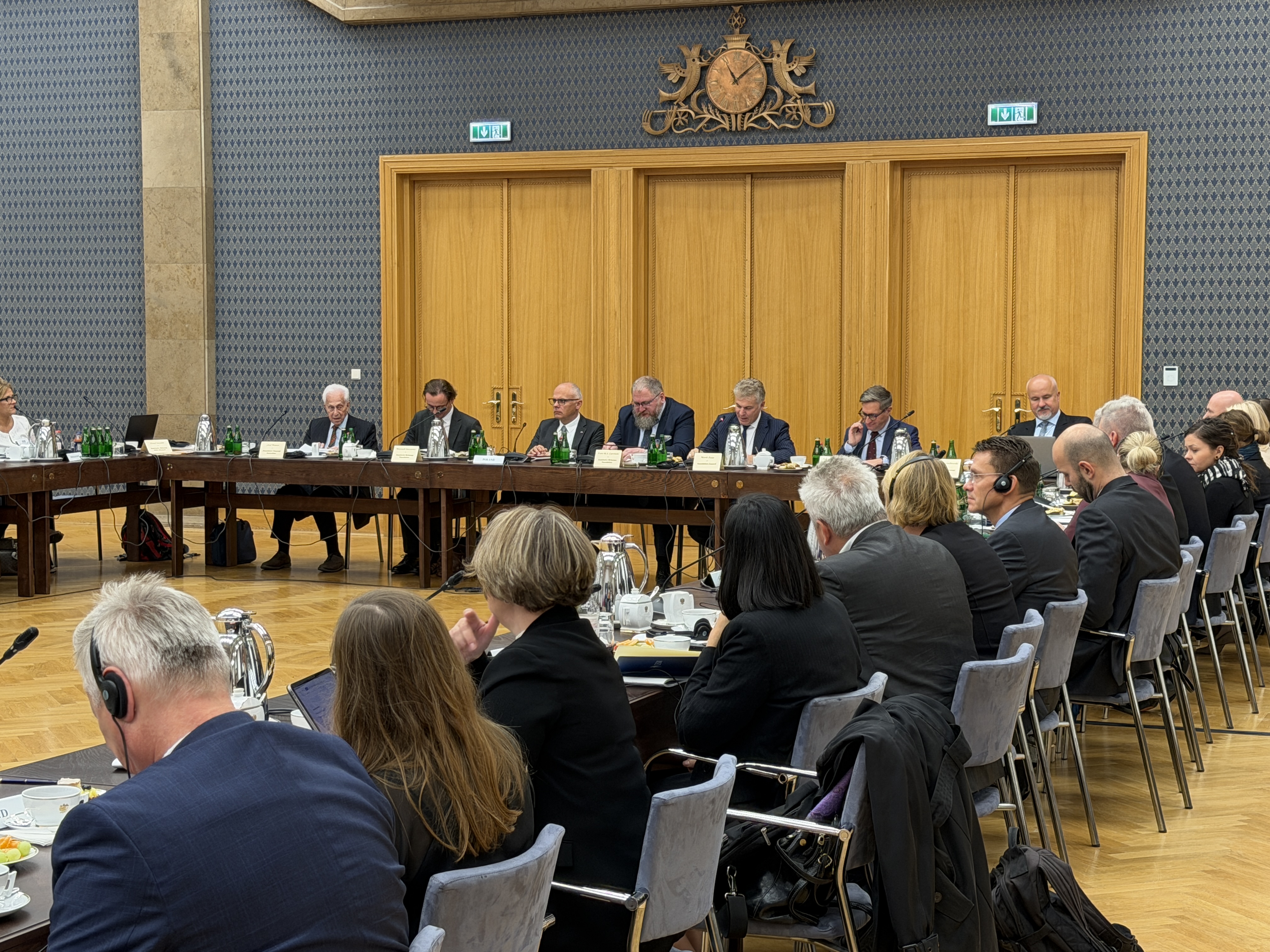
On 15 October, the 16th meeting of the International Committee of the Auschwitz-Birkenau Foundation was held at the Chancellery of the Prime Minister in Warsaw. The meeting brought together representatives of countries supporting the Foundation’s efforts to preserve the Auschwitz Memorial. It was chaired by Marek Zając, Chairman of the Foundation Council. New Committee members representing Montenegro and North Macedonia took part in the meeting for the first time.
On behalf of Prime Minister Donald Tusk, the participants were welcomed by Grzegorz Karpiński, Deputy Head of the Chancellery of the Prime Minister. “The Foundation is a unique example on a global scale of international solidarity in the field of protecting historical heritage. We meet united around a shared goal: preserving the memory of the victims of the Holocaust and counteracting antisemitism and all forms of intolerance. The Committee’s activity is not limited to its meetings, but represents an ongoing commitment to ensure that memory remains a source of strength and an inspiration for respect and tolerance,” he said.
Opening the meeting, Marek Zając emphasized the importance of preserving the authentic remains of Auschwitz for future generations. “We live in very difficult times, and many things are changing for the worse. That is why the lessons of Auschwitz and the Holocaust are needed today more than they were ten or twenty years ago.”
“The most important capital of any foundation is trust and transparency. This is precisely why these meetings are so important to us. We want to present our reports, but we also want to answer all your questions,” Marek Zając added.
Dr Piotr M. A. Cywiński, President of the Auschwitz-Birkenau Foundation and Director of the Auschwitz Museum, drew attention to the growing importance of historical memory in the face of contemporary crises and uncertainty.
“We do not know what will happen in three or six months. Changes are taking place very rapidly. This is precisely where the special role of memory becomes apparent. For me, memory is closely connected with human experience. When we do not know where we are heading, we turn to our experiences in order to better understand the situation and the possible paths of action. Our aim is to help people find that understanding. That is why we must protect and preserve the authenticity of Auschwitz,” Piotr Cywiński emphasized.
Wojciech Soczewica, Director General of the Auschwitz-Birkenau Foundation, presented a report on the Foundation’s activities and the most important projects carried out in the recent period. He spoke about the continued expansion of the international coalition of donors. Croatia, North Macedonia, Serbia and Slovenia have joined the group of countries supporting the Foundation, while Cyprus, Ireland, Portugal and Spain have increased their existing financial commitments.
One of the topics discussed was the Foundation’s additional work to protect authentic historical documents. In November 2025, an auction of more than 600 documents originating from concentration camps, ghettos and other sites of German Nazi crimes was planned in North Rhine-Westphalia, Germany. A significant part of the collection consisted of letters and postcards written by prisoners, many of them from Auschwitz.
Although the auction was cancelled, some of the materials remained on the private market. Through cooperation with the authorities of North Rhine-Westphalia, German memorial institutions and private donors, the Auschwitz-Birkenau Foundation became involved in securing more than 600 historical documents so that they could be transferred to the appropriate archives and museums.
“It was a difficult decision, because the Foundation had not previously been involved in purchasing documents from the private market. We concluded, however, that these testimonies of human suffering and the fates of specific individuals should be preserved and made accessible in memorial institutions, rather than ending up in private collections. We have no doubt that this was the right course of action,” Wojciech Soczewica emphasized.
Some of the documents have already been transferred to memorial institutions during a ceremony in Düsseldorf. Several hundred more are expected to be delivered to Polish institutions in the coming days, including the Auschwitz Museum and archives holding materials related, among others, to the ghettos in Łódź and Warsaw, as well as KL Stutthof and KL Lublin.
The Foundation also launched a special fundraising campaign to rescue historical documents, raising around EUR 140,000. These funds are intended to secure further testimonies and transfer them free of charge to memorial institutions. Wojciech Soczewica also pointed to the need for a discussion at the European level on the rules governing the trade in documents connected with Nazi crimes.
Another major project supported by the Foundation is the permanent exhibition of art by prisoners and Auschwitz Survivors currently being prepared by the Museum. It will be created in the historic former camp kitchen building at Auschwitz I. The project will make it possible to present an exceptional collection of works that constitute personal testimonies of camp experiences and their memory. The estimated cost of the project is around USD 24 million. Approximately USD 13 million has been secured so far. Donors include, among others, the Jusidman Family Foundation. The Foundation continues its fundraising campaign for this purpose.
Wojciech Soczewica also presented the development of educational activities supported by the Foundation, in particular the “Auschwitz. In Front of Your Eyes” platform, which makes it possible to visit the Memorial online, live with a guide.
An important part of the meeting was the presentation of the Foundation’s financial situation. Chief Financial Officer Elwir Świętochowski reported that in 2025 investment income from the Endowment Fund exceeded PLN 20 million. During the same period, the Foundation transferred PLN 23.4 million for the implementation of the Global Preservation Plan at the Auschwitz Memorial.
Łukasz Rozdeiczer-Kryszkowski, Vice-President of the Foundation, presented the results of an independent financial audit carried out by KPMG. The auditor raised no reservations regarding the 2025 financial statements, confirming that they fairly presented the Foundation’s financial position and complied with applicable regulations. He also thanked the companies and institutions that have supported the Foundation for years with their expertise, services and commitment, including KPMG, Rymarz Zdort Maruta, PZU, BNP Paribas, Orange and Google.
Rafał Pióro, Deputy Director of the Auschwitz Museum responsible for preservation, and Agnieszka Tanistra-Różanowska, who heads the Global Preservation Plan, discussed the implementation of the programme.
In 2025, 14 preservation projects were completed, while 11 are underway in 2026. Comprehensive safeguarding work continues at the ruins of the gas chambers and crematoria at the former Auschwitz II-Birkenau camp, including measures designed to protect surviving structural fragments from soil pressure and the progressive degradation of materials. Preservation work is also continuing on historic barracks in sector BI of the former Birkenau camp. Work was recently completed in the oldest camp washroom, which is now accessible to visitors. Work on two further buildings, a residential barrack and a sanitary barrack, is expected to be completed soon.
Museum conservators are also working on historic wall paintings and inscriptions preserved in buildings of the former camp, as well as on objects from the Collections. Particular importance is attached to documenting all interventions, including through the use of multispectral photography, Geographic Information Systems (GIS) and Building Information Modeling (BIM) technology. These tools make it possible to monitor the condition of historic structures in detail and to plan future work.
Museum representatives emphasized that international support makes it possible to carry out a long-term, systematic preservation programme whose aim is not only to safeguard the authentic remains of the German Nazi concentration and extermination camp Auschwitz, but also to preserve them and make them accessible to future generations.
In the context of the approaching 80th anniversary of the establishment of the Auschwitz Museum in 2027, Director Piotr Cywiński also recalled the particular responsibility to preserve the legacy left by former prisoners, on whose initiative the Memorial was created.
“We are living at a time when the last witnesses of history are passing away. We must do everything we can to ensure that their message remains alive. This is one of the most important tasks of the Memorial, the Foundation and all of us. Thank you for your presence and for the international solidarity that unites us around shared values,” the Museum Director said.