

News
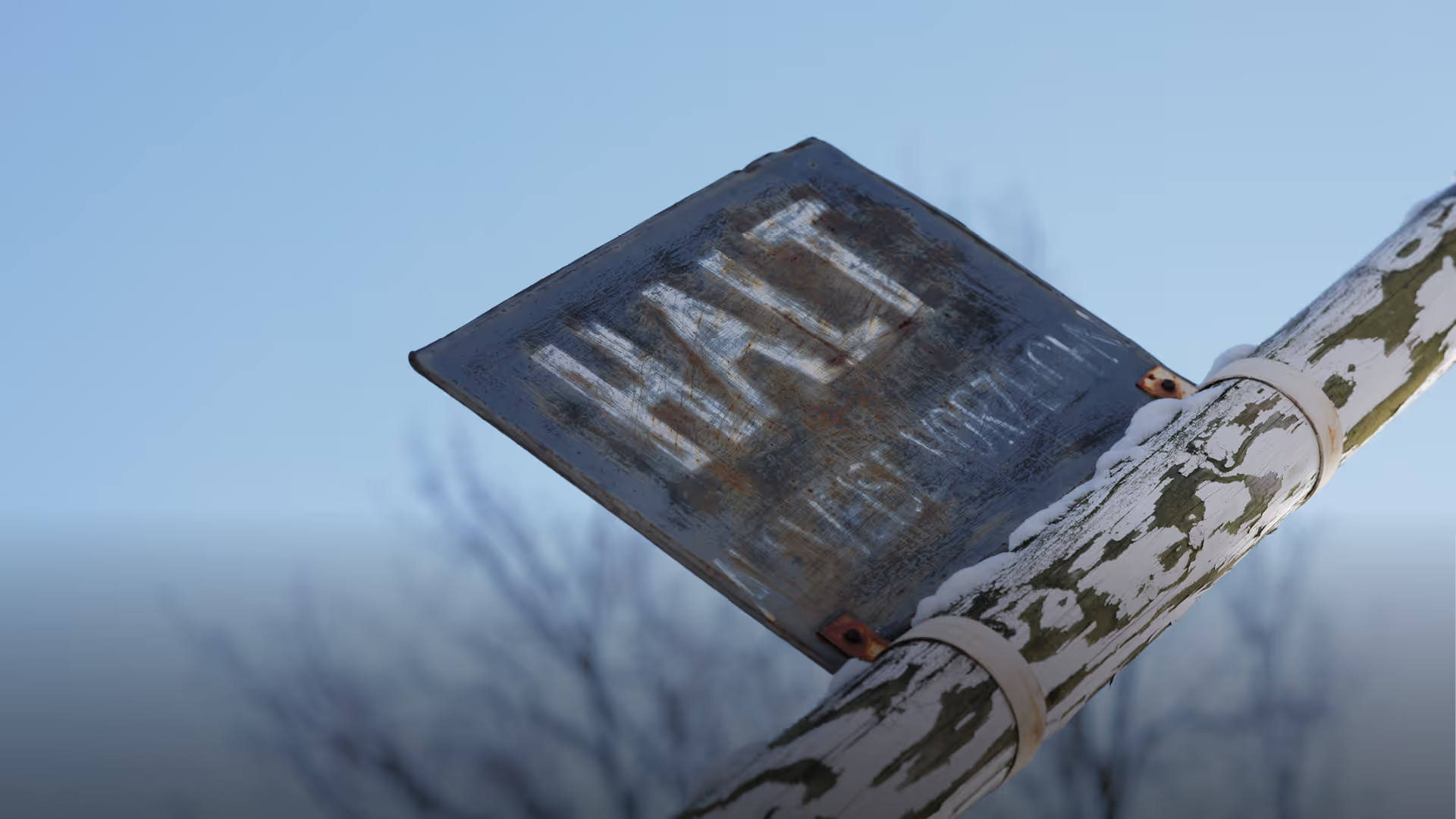
Montenegro is the 44th country to support the Perpetual Capital of the Auschwitz-Birkenau Foundation. This endowment fund makes it possible to preserve the authenticity of the remains of the German Nazi concentration and extermination camp Auschwitz.
Montenegro's support will amount to €22,300.00 and is part of a total contribution of one million euros from the countries of the former Yugoslavia. The agreement to this effect was signed on June 9, 2026, at the Embassy of Montenegro in Warsaw.
"Preserving the authenticity of Auschwitz is not a task for a single nation or institution – it is our shared responsibility for the difficult memory we carry as an international community. The gesture made by Montenegro and the other countries in the region proves that solidarity in the face of history is the underpinning upon which we build a secure, European future," emphasized Wojciech Soczewica, Director General of the Auschwitz-Birkenau Foundation.
Ambassador Veljko Milonjić expressed his satisfaction with the signing of the agreement. He emphasized that the concluded agreement represents an important step toward strengthening cooperation and building lasting relations between Montenegro and the Auschwitz-Birkenau Foundation.
The objective of the Auschwitz-Birkenau Foundation includes funding the Master Plan for Preservation – a long-term program aimed at securing all remaining camp vestiges. The overriding value guiding these efforts is the maximum preservation of the authenticity and clarity of the former camp's space for future generations.
Since 2012, the Foundation has already transferred over 172 million PLN to the Museum for conservation work, including 24 million PLN in 2025. The total value of the Foundation's Perpetual Capital stands at over 754 million PLN.
On 13 May, Members of Parliament from North Macedonia took part in an online tour of the Auschwitz Memorial via the “Auschwitz. In Front of your Eyes” platform. The event was organized together with the Auschwitz-Birkenau Foundation.
“The Auschwitz-Birkenau Foundation is proud to partner with the Parliament of North Macedonia to bring the authentic site of the former German Nazi concentration and extermination camp to the screens of lawmakers. In an era where historical distortion and antisemitism are on the rise, political leaders have a unique responsibility to lead by example,” said Wojciech Soczewica, Director-General of the Auschwitz-Birkenau Foundation.
Rashela Mizrahi, a Member of the Parliament of North Macedonia, said that remembrance is not only about honouring the past—it is a moral obligation to the future: „The role of parliamentarians and parliaments is essential in this effort. As the houses of the people, they bear a responsibility not only to legislate, but to protect historical truth, to safeguard memory, and to ensure that distortion and denial never find space to take root. Through education, open dialogue, and principled leadership, they must stand firmly against indifference and revisionism.”
“To remember is to stand against silence. To protect the truth is to defend our shared human values. This responsibility belongs to all of us—but especially to those entrusted to lead, to preserve, and to ensure that such darkness is never allowed to rise again,“ she emphasized.
The online visit allows participants to see both parts of the former German Nazi concentration and extermination camp: Auschwitz I and Auschwitz II-Birkenau, from anywhere in the world.
The guide’s narration is delivered live, with the possibility of interaction. In addition, the educator uses multimedia materials, archival photographs, works of art, and testimonies of Survivors.
“The virtual tour is not merely a technological feat; it is a bridge to the truth for those who shape the laws and values of our societies. We call upon national parliaments worldwide to join this initiative, utilizing this tool to fortify their commitment to 'Never Again' and to ensure that the lessons of the Shoah remain at the heart of modern democratic leadership," emphasized Wojciech Soczewica.
The special platform “Auschwitz. In Front of your Eyes,” dedicated to the Memorial, was developed through cooperation between the Museum, the Auschwitz-Birkenau Foundation, and the companies AppsFlyer and DISKIN.
The online visit is designed for groups such as schools, universities, educational institutions, museums, and companies. A group can participate together, using a single screen in a larger room, or individually, with each participant using their own device. Visits can be booked via the website visit.auschwitz.org.
All institutions wishing to arrange online visits for a larger number of groups on different dates are asked to contact the Auschwitz-Birkenau Foundation individually at: education@fab.org.pl.
Professor Jürgen Rüttgers, a member of the Auschwitz-Birkenau Foundation Council, was honored with the "Light of Remembrance" award – the highest distinction of the Auschwitz Museum. The award was presented to him on April 29 in Düsseldorf by Auschwitz Museum Director Dr. Piotr M. A. Cywiński. A particularly significant aspect of the laureate's public service is his commitment to preserving the authenticity of the Auschwitz Memorial.
As Prime Minister of North Rhine-Westphalia, and also after retiring from politics, Jürgen Rüttgers was among those politicians who supported the commitment of both the German federal government and the German federal states to the Auschwitz-Birkenau Foundation, whose goal is to finance long-term preservation work and protect all authentic remains of the Auschwitz camp.
"The establishment of the Auschwitz-Birkenau Foundation, and thus the entire process of preserving authenticity, would have been impossible without the personal involvement of Professor Jürgen Rüttgers from the very beginning of this project." "He understood perfectly how important it is to engage with authenticity in the education of future generations, especially those who did not experience the atrocities of World War II and the Holocaust, nor could witness the enormous post-war effort of building a common Europe," said Dr. Piotr M. A. Cywinski, director of the Auschwitz Museum.
Jürgen Rüttgers's crucial role was primarily in reinforcing the belief that the authenticity of all remnants of the German Nazi concentration and extermination camp Auschwitz must be secured by a stable, international support system.
Jürgen Rüttgers was born in Cologne in 1951. He studied law and history. From 1987, he was a member of the Bundestag, where he focused primarily on science, technology, and education policy.
From 1994 to 1998, he headed the Federal Ministry of Education, Science, Research, and Technology, and from 2005 to 2010, he served as Prime Minister of North Rhine-Westphalia. After retiring from active political life, he remained active in public life as a lawyer, academic, and member and collaborator of institutions dealing with historical memory, international dialogue, and German-Polish and German-Israeli relations.
The "Light of Remembrance" is an award established and awarded by the director of the Auschwitz-Birkenau State Museum for outstanding contributions to education about Auschwitz and the Holocaust. It honors individuals dedicated to preserving and transmitting the memory of the German Nazi concentration and extermination camp Auschwitz.
To date, this award has been presented to Professor Władysław Bartoszewski, Krystyna Oleksy, Avner Shalev, Serge Klarsfeld, Luis Ferreiro, Romani Rose, Piotr Setkiewicz, and Michael Berenbaum.
On the occasion of Yom HaShoah, the Jewish calendar’s Holocaust Remembrance Day, Vice-President Sabine Verheyen, Vice-President Pina Picierno and Member of the European Parliament Oliver Schenk, together with the Auschwitz-Birkenau Foundation, hosted a special commemoration at the European Parliament.
Held in the days surrounding Yom HaShoah, the commemoration aimed to honour the victims of the Holocaust and to underline the responsibility of European institutions to preserve the memory of the Shoah. At a time when the willingness to remember is fading and public attention is increasingly fragmented, the organisers stressed the importance of keeping that memory alive and warning against the dangers of dehumanisation, antisemitism and indifference.
“Thousands of people took part in the March of the Living from Auschwitz to Birkenau yesterday. Here in the European Parliament, too, we must speak about history, pass on its lessons and warn against the dangers of antisemitism, so that this threat never returns,” First Vice-President Sabine Verheyen stated. She underlined that the European Parliament stands firmly against hatred of Jews in Europe and remains determined to confront antisemitism in all its forms.
“It is our commitment to combat antisemitism in Europe with all the means at our disposal. That is why we worked across political groups to bring the Auschwitz-Birkenau Foundation to the European Parliament. This initiative like no other allows participants to experience this visit virtually and engage directly with guides on site. It is truly a unique learning experience and remembrance opportunity at once” - First Vice-President Sabine Verheyen said.
“Remembrance is never abstract. It becomes real when we see the names on the suitcases, the shoes of the victims and the traces of lives that were destroyed. Auschwitz shows us what happens when people are stripped of their dignity and reduced to numbers. Remembering the Shoah is therefore not only a moral duty; it is also a political responsibility. A democratic Europe can only remain strong if it defends historical truth, confronts antisemitism and rejects every attempt to relativise or forget the crimes of the Holocaust. To turn away from remembrance would be to turn away from the very foundations of our democracy” - Member of the European Parliament Oliver Schenk stated.
The Auschwitz-Birkenau Foundation welcomed the opportunity to bring the memory of the Memorial Site into the European Parliament and stressed the importance of education and remembrance in preventing hatred and intolerance.
“Auschwitz is not only a place of memory, but also a warning. Every generation must understand that hatred, exclusion and antisemitism do not begin with violence, but with words, indifference and the denial of human dignity. We are grateful to bring this message to the European Parliament together with our partners,” Wojciech Soczewica, Director General of the Auschwitz-Birkenau Foundation, said.
“Auschwitz symbolizes the deepest fall of European civilization, against which the entire post-war European community’s efforts were built and the European Union was founded. Those who stand before the remains of Auschwitz should have a clear understanding of this. Democracy, human dignity, and freedom can never be taken for granted. Our task is not only to preserve the site but also to preserve the truth and pass it on people who are willing to listen to shape their moral responsiblities today,” said Dr Piotr Cywiński, Director of the Auschwitz-Birkenau State Museum.
The organisers reaffirmed their commitment to continue working actively to identify, combat and prevent antisemitism, regardless of where it comes from.
The event featured a live guided virtual tour of the former German Nazi concentration and extermination camp Auschwitz. Participants were guided in real time by an educator thanks to “Auschwitz. In Front of your Eyes” platform, drawing on historical material, survivor testimonies and live images from both Auschwitz I and Auschwitz II-Birkenau sites. Throughout the event, participants had the opportunity to ask questions and engage directly with the guide.”
The Auschwitz-Birkenau Foundation has established a partnership with Echoes & Reflections, one of the most significant Holocaust education programmes in the United States. As a result, American high school teachers will be able to use the "Auschwitz. In Front of your Eyes" platform, which offers guided online tours of the Auschwitz Memorial and Museum for students.
In 2026, the Foundation and Echoes & Reflections will provide groups of teachers with free access to online tours. This will enable them to use this modern educational tool and later implement it in their own schools and communities.
"The potential scale of this cooperation is of particular importance to us. Since its launch in 2005, Echoes & Reflections has reached over 175,000 educators, who have the capacity to impact millions of students across the United States. This opens up a significant opportunity to bring education from the authentic site of the former German Nazi concentration and extermination camp Auschwitz into American classrooms," said Wojciech Soczewica, Director General of the Auschwitz-Birkenau Foundation.
“We are thrilled by this exciting new collaboration. The ability to bring U.S. educators virtually to this important site of Holocaust history, will in no doubt enhance their knowledge and teaching skills to deepen student learning and understanding,” said Lindsay J. Friedman, Managing Director of Echoes & Reflections.
As part of this joint effort, every online tour will be accompanied by an additional educational component prepared by Echoes & Reflections. This will include guidance for teachers on how best to prepare students for participation in a future online tour, as well as access to additional classroom materials and pedagogical recommendations. Echoes & Reflections will also develop a set of online resources to support teachers in preparing for and discussing the experience with their students.
For the Auschwitz-Birkenau Foundation, this collaboration represents an important step in expanding the international reach of Auschwitz and Holocaust education. Making the "Auschwitz. In Front of your Eyes" program available to teachers in the United States not only provides a way to reach a wide audience for whom a visit to the Memorial is often impossible, but also provides support for responsible, in-depth education based on authenticity and a reliable historical narrative.
Echoes & Reflections is a partnership program of Anti-Defamation League (ADL), USC Shoah Foundation, and Yad Vashem.